Project Bona Fide
An off-grid permaculture farm on Ometepe Island, Nicaragua, in 2013: one pair of shorts, digging and hauling water, and the first chocolate I ever made.
At a glance
- Role
- Volunteer
- When
- April to May 2013
- Where
- Balgüe, Ometepe, Nicaragua
- Scope
- Farm labor and permaculture study on an off-grid education farm

Results
- May 2013The first chocolate I ever made, in a cook’s home on Ometepe
After Rancho Margot I headed north to Nicaragua, wanting to go deeper into permaculture without knowing where. In early April 2013 I stalled the rental car five times before I made it out of the lot in San Juan del Sur. A few weeks later I was living on a farm on Ometepe, the island of twin volcanoes in Lake Nicaragua.
No walls, no door
It was my first time in Nicaragua. My first nights in San Juan del Sur I stayed at Casa Oro, the chill-yet-social hostel in town. I had no idea what that building would become for me.
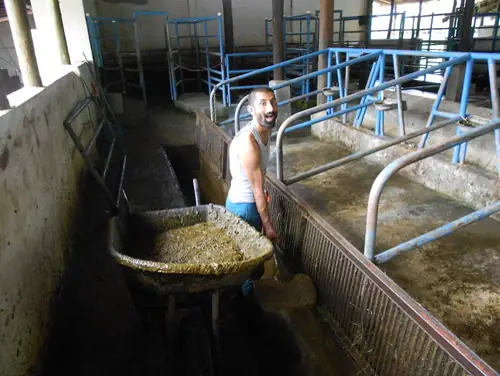
Project Bona Fide, in Balgüe, is an off-grid permaculture education farm. Volunteers worked five or six hours a day, five days a week, and paid $250 a month for the education, the food and a bed. Mine was a slice of foam under a mosquito net in an open-air hut. No walls. No furniture. There wasn’t even a door. I wore one pair of shorts, no shoes and no shirt, and bathed in the lake. I did all the manual grunt labor: dug holes, gardened, carried water, fed termite nests to the chickens, killed scorpions. The toilet was a wooden seat over a container and two scoops of sawdust; over time it all turned into soil.
It was nothing like Chicago, and it felt strangely natural.
Design inspired by nature
Permaculture is design inspired by nature, and I studied it the only way that stuck: reading, asking questions, and getting my hands and feet very dirty. A composting toilet, a food forest, a roof that catches its own water. Each one solves a problem by copying a pattern something wild already worked out.
I started seeing those patterns as answers to problems in business and in society too. I also knew I was an infant in this world, and I wanted to keep learning.
Chocolate, by hand
In May 2013, at a home on the island, a local cook named Clemen invited us into her home to learn to make Nicaraguan chocolate. I’d never done it. I posted a photo the same day: learning to make real chocolate from a Nicaraguan boss woman, who wants some? Six years later I started a chocolate company in San Juan del Sur, a short trip south of that kitchen.
What came next
A week before I left Bona Fide, an email came from Victor Saad: he was starting a school called the Experience Institute. It smelled like synchronicity. I joined the founding class that fall and spent the next year turning what I’d started on farms in Costa Rica and Nicaragua into practice.
What I did
- Signed on at an off-grid permaculture education farm on Ometepe: five or six hours of work a day, five days a week
- Dug holes, gardened, hauled water, fed termite nests to the chickens and killed scorpions
- Lived in an open-air hut with no walls and no door, in one pair of shorts, and bathed in the lake
- Studied permaculture design by reading, asking questions and getting my hands and feet very dirty
- Made chocolate for the first time, in May 2013, in the home of a local cook, Clemen
- Wrote and photographed the whole stint on the blog
Deliverables
- Daily farm labor for Project Bona Fide’s gardens, water and animals
- My first batch of Nicaraguan chocolate, made by hand with Clemen
- Field notes and photos from Ometepe on the blog
Skills
- Permaculture design basics
- Manual farm work: digging, planting, hauling water
- Living and working off the grid
- Learning a new field fast, by doing it
What I learned
Nature has had billions of years of research and development. On Ometepe I started looking there first.
Related work
Rancho Margot
Volunteer
Volunteering at an off-grid ranch in Costa Rica in 2013: compost, corrals, gardens, and an Excel farm-management system built between shovels.
El Castillo, Costa Rica, 2013

Experience Institute
Founding student
A self-designed graduate year at the Experience Institute, 2013 to 2014: three apprenticeships in Australia, the Philippines and Chicago, and one question.
Chicago, Australia, the Philippines, 2013 to 2014
The Simple Good
Co-founder
The Simple Good, my first project after PwC: a crowd-sourced photo blog of small good things every culture shares. My co-founder still carries it on.
Chicago, 2011 to 2012