About
I’m Muffadal Saylawala. Call me Muffa. Accountant by training, builder by choice. I grew up outside Chicago, left a fast track at PwC to learn how things really work, and have spent the years since learning it with my hands, in Nicaragua and back home.
Where I come from
I come from a family of bridge crossers: both my parents were born in Pakistan, and I was born outside Chicago. I grew up in the suburbs, raised in the Dawoodi Bohra community, a community of traders. Fair dealing came with the faith. My mother’s family name is Soniwala, which means gold people; her family are jewelers in Pakistan to this day. My father’s side takes its name from Sayla, in India. Years later, the hostel we bought in San Juan del Sur was already called Casa Oro. I kept the name. The expectations at home were clear: smart, brown, so a doctor. A brain surgeon, ideally. There were a lot of boxes to check, and I meant to check all of them.
I had a severe speech impediment and did well in school anyway. I earned degrees in finance and accountancy at the University of Illinois, spent my summers in Kenya and Oman, and landed the job I was supposed to land, at PwC. The more boxes I checked, the less sure I was what they were for.
The turn
Profit was the only number anyone measured. I believed then, and still do, that business is the strongest tool we have for social and environmental good. So in 2011 I left to find out how. Two startups taught me what I didn’t know. Travel did the rest: more than 50 countries, and a worldview that kept breaking and rebuilding.
At the end of 2012, in Costa Rica, I kept asking what “eco” actually meant. On 21 December, at a brewery on Lake Arenal, I wrote down my answer: grow real food, build with natural and recycled materials, and connect travelers with the people who live there. I’ve been building it ever since.

Learning it
I volunteered on farms in Costa Rica and Nicaragua, and learned to see a forest, a farm and a community as one system. I started borrowing nature’s patterns. Then a founding year at the Experience Institute: a Permaculture Design Certificate at Zaytuna Farm in Australia, a typhoon shelter in the Philippines, design thinking at Leo Burnett. In 2018 I went back for more: Bamboo U at the Green School in Bali, then the Earthship Academy in Taos, New Mexico.
Building it
In 2015 I moved to San Juan del Sur, Nicaragua. We bought land in El Carrizal first; that October, with partners, I bought the town’s first hostel, and Casa Oro Group grew from there: five guesthouses, three places to eat, tours, shuttles and Rancho Regeneración, 80 acres that are now a registered private reserve. I did the design, the engineering and the calculations, built it with local crews in Spanish, and stayed down to making the beds. When a storm brought one property’s hill down, I rebuilt it into the hill.
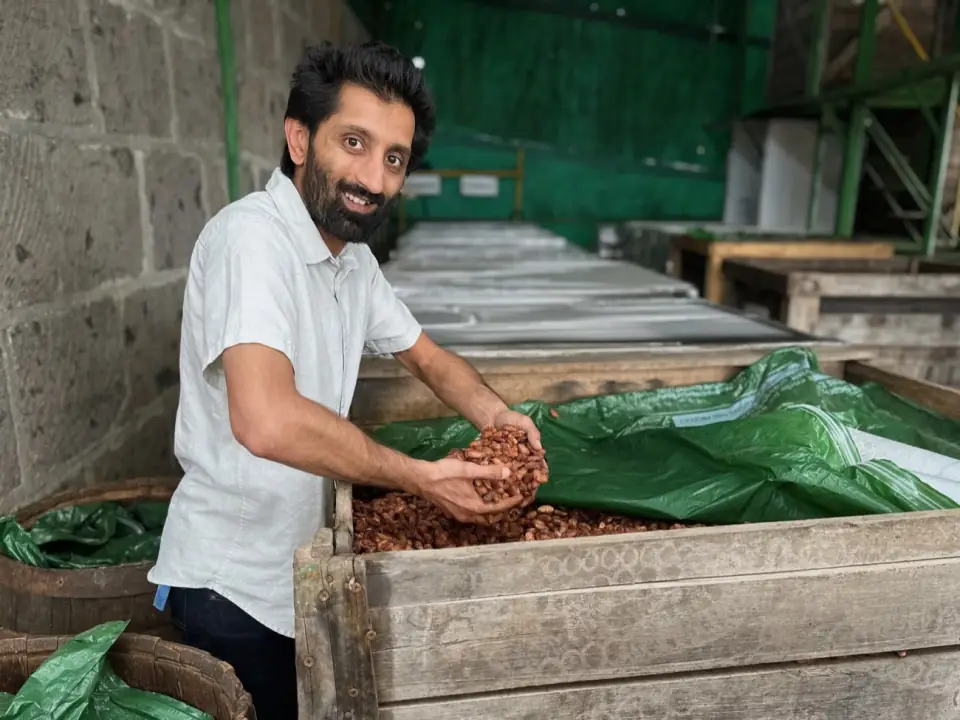
In 2019 I turned to chocolate, made in Nicaragua from Nicaraguan cacao. In 2021 I bought a former shoe store in Wicker Park and ended up as my own general contractor (not by choice). In November 2023, after two years of building, Oro Chocolate & Coffee opened in Chicago. Everything I’d learned in Nicaragua came home to Chicago.

Four companies, one chain
I lead Oro Chocolate & Coffee and Casa Oro Group. I’m a managing partner in Reserva Los Nogales, a rainforest reserve and regenerative coffee farm, and partner and CFO of Ingemann, whose agroforestry program has planted more than a million trees with Nicaraguan cacao farmers. At night I build the software that connects all four.
I split my time between Chicago and Nicaragua. My hobby, it turns out, is building really complex businesses.
What drives me
I want to know how things work, all the way down. Who grew the cacao in a bar, and who fermented it. Why an earth wall stays cool. Why one team thrives under a manager and another doesn’t. I’ve never been good at stopping at the first answer. I’m a builder and a process nerd, and the thing that really moves me is trees.
I’m at home in rooms that don’t usually share a table: a farmer at dawn, a banker at noon, a long conversation about meaning after dinner. I take the unseen seriously, and I still check everything against what actually happens. People, places and money are messy, and I’d rather work in the mess than pretend it isn’t there.
Off the clock, I’m a yogi: hot yoga most days, the harder and sweatier the better, a practice I’ve kept since before my farm days at Rancho Margot. I’m happiest outside. Give me a long walk with no plan, a wrong turn on purpose and whatever is around the next corner, in a cloud forest or a city I don’t know yet. In Chicago that means a black 1970s Schwinn with red handlebars, made here, out whenever the weather allows.

Where I can help
If you’re building something that should leave a place better than it found it, I can probably help with a piece of it: the numbers, the building, the guest experience, the supply chain, or the systems that run it. I’ve already made most of the mistakes, so you don’t have to. Write to me at me@msayla.com.
What I believe
Regeneration: leave people, places and economies better than I found them. Courage isn’t being fearless; it’s noticing the fear, putting it in its place and moving forward. At a retreat in Costa Rica in 2015 I gave a 30-second pitch to the room; 10 of the 30 seconds were spent stuttering, and I smiled and held eye contact the whole way through. Quality is decided upstream. Credit the hands: the team is the proof. And still, after all of it, the question: how might we redesign society to be more whole?
I needed to figure out how I could build a bridge between the hippie world and the business world.